


-
- News Center
- Related News
-
- Aluminum Plate 5083 H111 VS H116
- 2015 Haomei Annual Meeting of the New Year
- Aluminum 5083 H111 an
-
- Aluminum Plate 5083 H111 VS H116
In the export procurement of 5083 rust-proof aluminum plates, H111 and H116 are two work hardening states that are easily confused. Both belong to the H1 strain hardening system and have completely identical basic alloy compositions, but their processing directions, performance boundaries, and applicable scenarios are fundamentally different. As two mainstream delivery states of high-magnesium aluminum-manganese alloys 5083, clarifying their commonalities and core differences is crucial for accurate selection, cost control, and ensuring service life in marine engineering and corrosion protection projects. This is also a technical detail that is easily overlooked in many procurement processes.
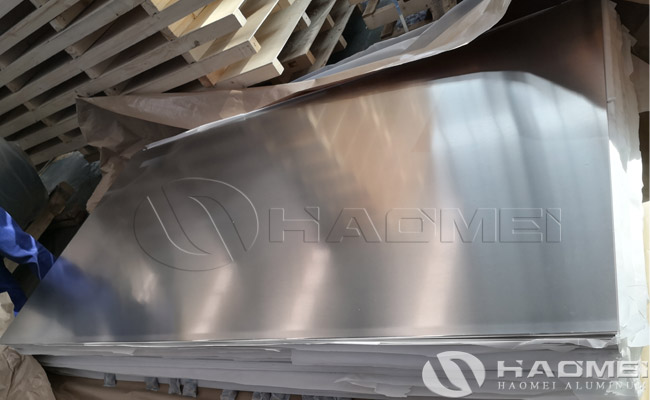
Their underlying commonality of 5083 h111 and 5083 h116 stems from the same alloy system and work hardening logic, with highly similar basic properties. Both H111 and H116 are produced based on the aluminum 5083 standard composition, with magnesium content controlled at 4.0%~4.9% and chromium content at 0.05%~0.25%. They retain the natural atmospheric corrosion resistance, rust prevention, and moderate strength characteristics of aluminum-magnesium alloys. Neither requires solution heat treatment for strengthening; their manufacturing process involves hot rolling followed by cold rolling for thickness control and low-temperature annealing. Their formability is superior to higher-hardened states like H32 and H112, making them suitable for conventional bending, rolling, and other cold working processes.
The difference in process definition and manufacturing logic is the root cause of their performance divergence, as their annealing objectives are completely different. H111 undergoes "moderate stress relief annealing after work hardening," and after final rolling, it is annealed at a low temperature of 260℃~310℃ to only relieve some work hardening stress. There are no mandatory quantitative requirements for the degree of strain hardening; the core objective is to balance formability and basic strength. H116 is a special state specifically designed for 5xxx series aluminum alloys with a magnesium content ≥3%. It employs stabilization annealing at 200℃~250℃, with strict control over rolling deformation rate and annealing process window. The core objective is to ensure the alloy passes intergranular corrosion resistance tests while retaining work-hardening strength; it is a special state with mandatory corrosion resistance requirements.
The quantitative differences in mechanical properties directly reflect the difference in the degree of hardening, with a clear strength gradient between the two. Taking a standard thickness of 3.0mm~6.0mm aluminum plate as an example, the tensile strength range of 5083-H111 aluminum plate is 270MPa~330MPa, with a specified non-proportional elongation strength ≥145MPa and elongation after fracture ≥12%, indicating a preference for high formability. The tensile strength of 5083-H116 aluminum plate is increased to 305MPa~380MPa, with a specified non-proportional elongation strength ≥215MPa and elongation after fracture ≥10%, representing a strength increase of approximately 13%~25%. Sufficient cold working allowance is retained, meeting the load-bearing requirements of most structural components.
The implicit difference in corrosion resistance is the most easily overlooked core dividing line between the two, directly determining service life. The H111 temper has no mandatory intergranular corrosion testing requirements, and its corrosion resistance is comparable to the ordinary H1 work-hardened condition, suitable only for atmospheric corrosion and weakly corrosive media. The H116 temper, however, must pass the ASTM G67 standard intergranular corrosion test, requiring a mass loss per unit area ≤15mg/cm². This effectively avoids the risk of intergranular corrosion and exfoliation corrosion of high-magnesium aluminum alloys in salt spray and seawater environments, and is the marine engineering standard delivery condition recognized by major classification societies worldwide (DNV, LR, ABS).
When selecting between 5083 h111 and h116, it is necessary to match the appropriate condition to the application scenario to avoid performance redundancy or inadequacy. For applications such as general corrosion-resistant tanks, building envelopes, and marine interiors where molding is the primary requirement and corrosion intensity is relatively low, the H111 temper offers better cost-effectiveness, with a procurement cost difference of approximately 5% to 8% between the two for the same specifications. However, for highly corrosive load-bearing applications such as hull plating, offshore platform structures, curtain walls in coastal high-salt-spray areas, and seawater treatment equipment, the H116 temper is essential to ensure long-term service reliability. We can provide full-specification plates in both conditions, along with complete mechanical and corrosion testing reports, and support customized classification society certifications to meet the precise selection needs of different projects.-
- pre:pre:Applications of 3003 Aluminum Foil
- Next:next:none
- Haomei aluminum
- haomei Aluminium Plate